Frequently asked questions about Cellular Cosmology
Cellular Cosmology (German Zellularkosmologie) is a concentric cosmos model: the universe is a self-contained cell. At its centre, a luminous core (the Sun); arranged in rings around it, the planets and stars; at the outer boundary, the Earth — and we live on its inner, concave surface.
The decisive difference from the standard view: we do not live on a sphere in space, but inside a sphere whose inner surface is the Earth's surface. The standard model with Earth-in-outer-space, flying galaxies and an infinite universe appears, from this perspective, as a geometric inversion: the same observational material, but turned inside out.
Three different models often confused in popular discourse:
Cellular Cosmogony dispenses with mythological inhabitants and makes no claims about an "outer space beyond the shell" — it posits: what we call the universe is the whole system.
The modern model begins along two lines:
American: Cyrus Reed Teed (1839–1908), a physician from New York, had a vision ("Illumination") in 1869 during a half-hour coma in which a goddess revealed to him the structure of the cosmos. From this he developed the Cellular Cosmogony. In 1898, together with the geodesist Ulysses Grant Morrow, he published the eponymous main work. In 1897, Morrow conducted geodetic measurements in Estero, Florida, with the Rectilineator he had designed — a set of three precision-aligned square elements, levelled horizontally and then rolled forward along an exact straight line for roughly 4 km along the beach. The measurement series was intended to show whether Earth's surface curves upward (concave) or downward (convex) — the result supported the concave reading. The Koreshan Unity (later Koreshan Foundation) carried on the legacy after Teed's death, but ultimately could not defend the vision against the rising space-age propaganda — in particular against the first NASA satellite image of Earth on November 9, 1967.
German: Karl Edmund Neupert (1879–1949) published Der Kampf gegen das kopernikanische Weltbild in 1928 and Geokosmos — Weltbild der Zukunft in 1942. The German tradition is often portrayed as independent, but this is unlikely: Teed's Cellular Cosmogony had been circulating internationally since 1898, and without a celestial revelation like Teed's, no one can question the Copernican model from scratch — too much specific knowledge is required all at once. Neupert's familiarity with the American line is therefore to be assumed. Johannes Lang in 1938 provided the mathematically rigorous version with Die Hohlwelttheorie (inversion mapping). The tradition lived on in the German journal Geokosmos and in Walter Wawruska's two-part work Braucht die Menschheit ein neues Weltbild? ("Does humanity need a new worldview?", parts 1 and 2). Helmut Diehl (deceased — his legacy: innenweltkosmos.de) is widely thought to have inspired Rolf Keppler († 2025) to launch rolfkeppler.de — today an In-Memoriam page.
Academic inversion mathematics was contributed by Mostafa A. Abdelkader in 1981.
The organised English-language "modern Concave Earth movement" as such no longer exists: its founder Lord Steven Christ (born Steven Joseph Christopher) died on December 13, 2021, in a US federal prison from cardio-respiratory failure. Since then only unorganised remnants remain.
In the German-speaking world, the public Facebook group "Zellularkosmologie" has existed since 2010 with around 1,200 members — currently the only active German-language platform.
Imagine a vast sphere whose inner diameter equals roughly the conventionally assumed Earth diameter (≈12,756 km). The surface you stand on — soil, grass, concrete — is the inner wall of this sphere. When you look up, you are not looking into open infinite space, but into the interior of the sphere, at whose centre the Sun, planets and stars are located.
The apparent "downward" curvature (horizon) is explained by the optical properties of the interior: light does not travel in straight lines in our usual sense, but follows curved paths through a radial aether gradient. What we see as "the Earth from space" on satellite images is an optical phenomenon of this light curvature.
Plato is the earliest written source outlining the model:
In the Phaedo (108e–110b), Socrates describes: the Earth is round, rests at the centre of the universe, and we live not on its surface but in one of its hollows (πολλὰ κοῖλα). What we call heaven is merely the sediment of the true aether. The "true Earth" lies pure in the pure heaven and, seen from above, appears like a twelve-piece leather ball — a geometric hint at the dodecahedron.
In the Timaeus (33b ff.), he describes the cosmos as the most perfect geometric figure: a self-enclosed sphere, a living, self-sufficient being — not metaphor, but cosmological architecture.
Cellular Cosmology reads both texts not as myth but as a compressed description of the real state of affairs. The full original text with translations can be found on the Plato page.
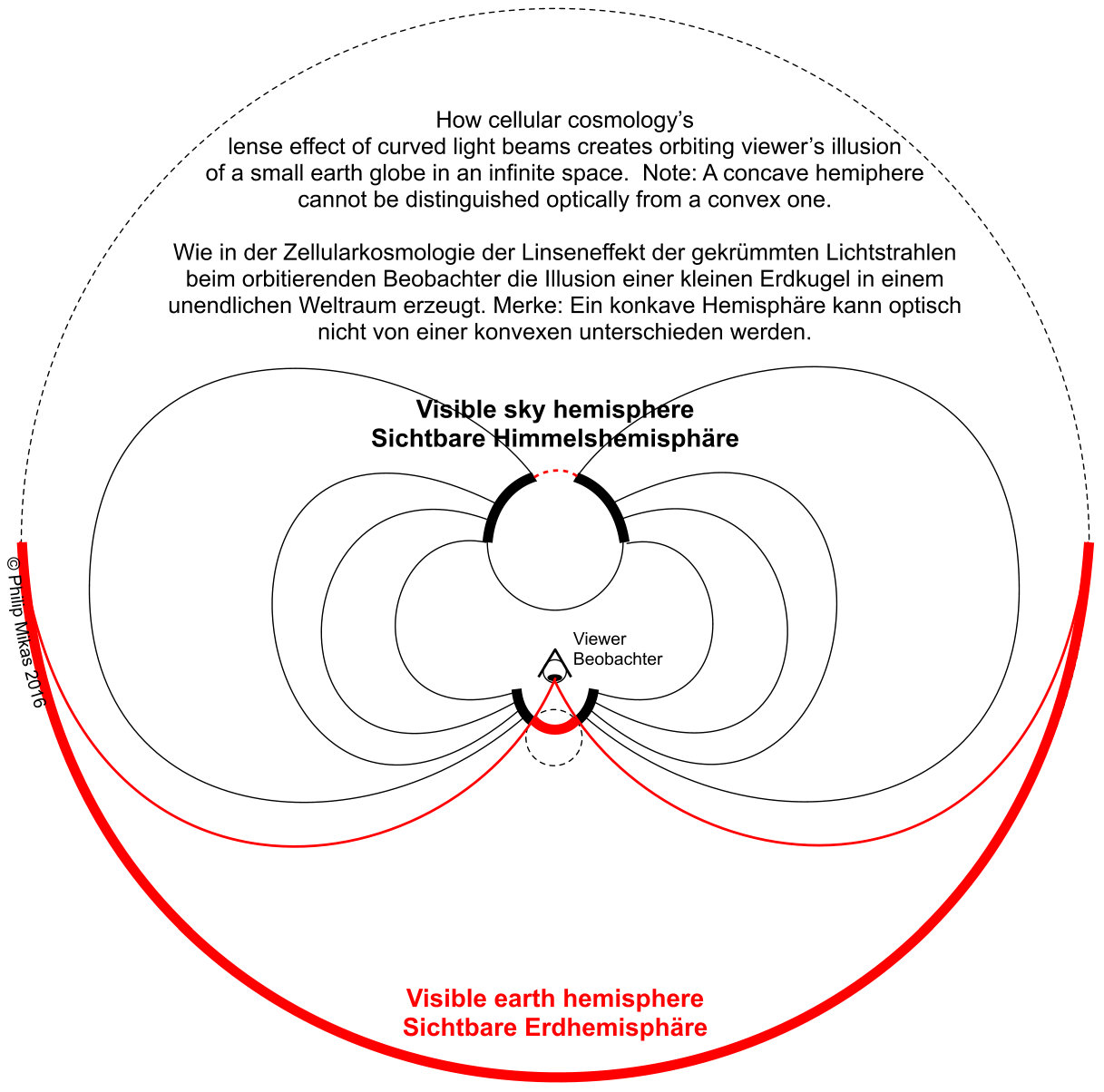
Light curvature at the aether gradient restricts the visible portion of the sphere to a small Earth circle (out to the horizon). Beyond that, the light curves toward the firmament, never reaching the remaining surface of the sphere. This light path holds for both emitted and received light.
This is also why the firmament appears disproportionately large and fills the entire sky — the curved light paths bundle all lines of sight onto the central celestial sphere.
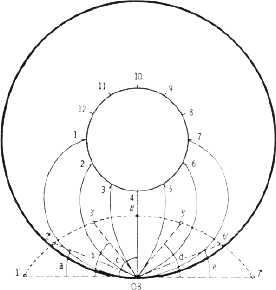
"How can light bend? It doesn't react to gravity, magnetism or electricity." That is the legitimate objection.
Light bends at the aether gradient, which densifies toward the centre. It follows the Snell refraction principle: the ray is refracted toward the denser phase.
Light also bends between air layers of different density: the Föhn effect arises from a warmer air layer above a colder one. The light is bent downward, the angle of incidence to the observer becomes steeper — and the mountain appears larger.
The gravitational lensing effect claimed by Albert Einstein, supposedly linked to the Sun's mass, contradicts Einstein's own theory of light: gravity requires two masses, yet light supposedly has no rest mass. Without rest mass it can have no inertial mass either — and therefore cannot be deflected by masses at all.
In the model, gravity acts radially outward — from the central Sun toward the concave surface of the Earth. It is a pressure-differential force that presses us perpendicularly against the Earth's surface.
The notion of an "attractive force" is naive. "Attraction" is not a physical concept like, say, pressure — it acts instantaneously, without carrier, without mechanical mediation. In the Cellular model, it is replaced by the pressure action of the aether (Le Sage gravitation), which geometrically can only act from the centre outward.
At the centre of the Cellular Cosmos lies the Black Sun — the star-studded firmament itself —, the singular oscillator and source of aether radiation.
Around it orbits the visible Sun, which transforms the cosmic radiation of the central sun (the Pythagorean "central fire") downward into visible light and heat. It is not a 1.4-million-km blazing ball at 150 million km distance, but a planet only a few kilometres across with a black surface (hence the sunspots!) and a corona, at a distance of roughly 4,500 km from the Earth's surface.
The Moon orbits the central Sun in a relatively low path above the Earth's surface. It is about 100× smaller than conventionally assumed — roughly 30 km in diameter instead of 3,000 km.
The other planets orbit the central Sun at roughly the distance they occupy in the Kabbalistic Tree of Life from Kether — the centre of the firmament. The classical association of planet ↔ sephirah thus becomes a geometric statement about real spatial distances.
The stars are not distant suns at unfathomable distances but points of light on the shell structure of the firmament.
This radically miniaturised and concentrically ordered picture is one of the hardest mental models for those exiting the standard view — but gains weight through its geometric and symbolic coherence.
Conventionally, solar eclipses occur when the Moon passes between Sun and Earth; lunar eclipses when the Earth passes between Sun and Moon so that its shadow falls on the Moon.
In the Cellular model, both bodies are inside the inner space:
Solar eclipse: the Moon comes between the central Sun and an observer on the inner wall — the same geometric scheme as in the standard model, just embedded in the bounded interior. The path of totality across the Earth's surface corresponds to the projection of the Moon's shadow on the inner wall.
Lunar eclipse: here it gets interesting. In the conventional model the Earth casts a shadow on the Moon. In the Cellular model this is geometrically impossible, since the Moon lies between Earth and Sun. Proponents explain lunar eclipses with a dark companion body ("Lunar X" or "anti-Moon") that periodically positions itself between Sun and Moon and obscures it — a concept already proposed by ancient astronomers (Anaxagoras, and Ptolemy's "black solar chariot").
Both explanations are observation-consistent; the lunar eclipse, however, remains the most delicate touchstone of the model.
Satellite images are mostly taken from altitudes <600 km. Even from this low altitude, the Earth is visible as a sphere — also as the famous "Blue Marble" (image from Apollo 17) in a black sea of stars.
The reason: the lens effect of light rays curved on the aether gradient creates, for an orbiting observer, the illusion of a small Earth globe in an infinite space. A concave hemisphere cannot be distinguished optically from a convex one — the visible Earth hemisphere is inverted by the light curvature into an apparently convex sphere.
The classic schoolyard argument: a ship vanishes at great distance "below" the horizon — hull first, mast last. Conclusion: convex Earth.
Cellular reply: the light ray is bent upward by the concentric aether gradient that densifies toward the centre. A ship on a concave surface can thereby submerge with its lower part below the upward-curving horizon line — the same optical effect as on a convex Earth, but with inverted geometry.
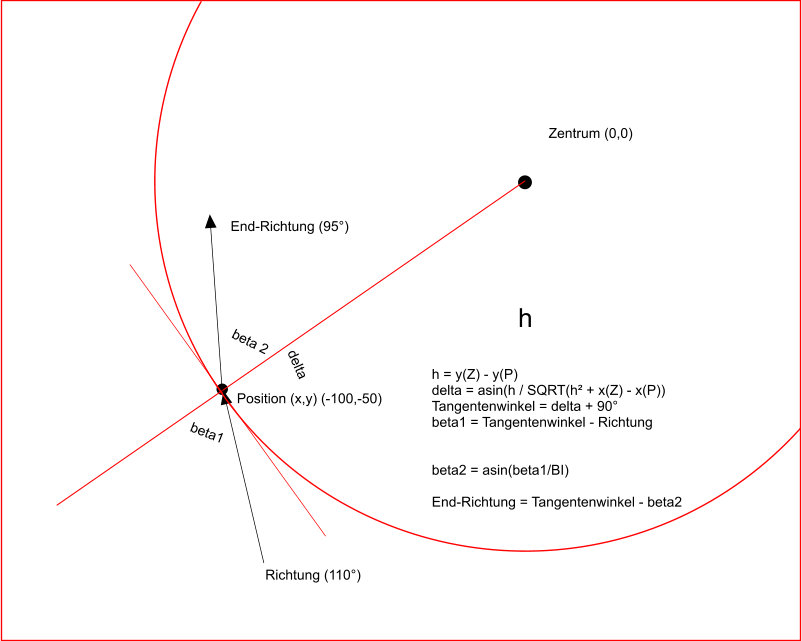
The fact that horizon-disappearance is compatible with both models is precisely why pure horizon observation does not decide between them (see question 6 on the horizon effect and question 13 on the decisive curvature experiments — Bedford, Morrow, Tamarack).
Four central pillars:
Bedford Level Experiment (Samuel Rowbotham, 1838): Bedford Level Canal, 6 miles of straight water surface. Rowbotham found no curvature — the water surface was visible horizontally to the far end. Repetitions by Alfred Russel Wallace (1870) confirmed curvature, but under refraction corrections that are themselves contested.
Morrow Rectilineator (Estero, Florida, 1897): Ulysses Grant Morrow built a 5-km horizontal steel structure on the beach of Naples, Florida. Measurements were taken over several weeks. Result: the water surface rose with distance — which under a convex Earth should not occur, and which exactly matches the concave hypothesis.
Tamarack Mine Experiment (Calumet, Michigan, 1901): in the roughly 1,300-m-deep vertical shafts of the Tamarack copper mine, plumb lines were suspended — heavy lead weights on fine steel wires. According to Newtonian physics, plumb lines all pointing toward the Earth's centre should converge with depth. The measurements found the exact opposite: at the bottom of the shaft, the plumb lines stood farther apart than at their suspension. In the convex-conventional model this is a scandal that remains unexplained to this day; in the concave Cellular model it is the geometrically expected behaviour — for there gravity points outward, away from the centre, and plumb lines diverge with increasing depth (that is, toward the shell wall).
Allais Pendulum Effect (Maurice Allais, 1954): during a solar eclipse, a Foucault pendulum showed an unusual deviation in trajectory — an effect not explainable by Newtonian gravity. Cellular proponents see this as evidence of a direct aether influence from the Sun.
These experiments have never been reproduced under fully open conditions; a modern repetition — especially of the Tamarack and Rectilineator tests — would be highly informative.
In recent decades, Rolf Keppler repeatedly attempted to obtain a physical proof — among other things, a measurement with a laser gyroscope at different locations was planned. One attempt he carried out together with Philip Mikas around 2005 failed embarrassingly: Rolf had bought an artificial horizon (the kind used in aircraft to determine the plane's tilt relative to the Earth's surface) and took it along on a 2,000-km flight from Memmingen to Lisbon. To our dismay, the horizon did not show the expected 30° deviation. Rolf later discovered that his device already had an internal correction mechanism built in.
Besides Rolf, the graphic designer Steven Christopher (who built a following as LSC — "Lord Steven Christopher") was also strongly engaged. He intended to repeat the Rectilineator experiment (1897 at Naples Beach, Florida) and had high-precision calibrated frames built for the purpose. But the experiment literally ran into the sand: the sandy beach made any precise construction impossible. LSC was so disappointed that he even came to suspect Cyrus Teed of being a fraud — after all, Teed too had "built on sand" (both literally and in the German idiom for unsound foundations). He did not turn his back on the theory, but the inner doubt seems to have left its marks. He died on 10 December 2022 (?) in a US prison under unclear circumstances.
From the Cellular view, the following phenomena are either unexplained, internally contradictory, or grotesque under the convex-conventional model (referred to below as "AC" for Acentric Cosmos). The Cellular Cosmos ("CC") provides a coherent explanation for each:
Gravity: "Attraction" is not a physical concept — it acts instantaneously, without carrier, without mechanical foundation. A mere (irrational) spacetime curvature would be only static. What remains is the explanation as a radial pressure-differential force. But such a force can only push from a centre against the Earth's surface — exactly as in the CC.
Tenfold intensity difference between morning and midday sun (measured with mobile PV modules): the angle of incidence to the sun stays at 90° on a tracking module. Since air does not absorb solar radiation, what remains as the only possible explanation is a change in distance to the sun itself. Astonishingly, this does not lead to a change in the sun's angular size, because the perspective shrinkage in the morning is exactly cancelled by an enlargement due to the lensing effect of light-bending in the aether gradient. The threefold distance in the morning yields, via the inverse-square law, a ninefold intensity reduction — closely matching the measured factor of 10.
Tides: spring tides at both new moon and full moon are a contradiction under the AC, because the forces of Moon and Sun should add at new moon but cancel at full moon. In the CC, Moon and Sun both press against the water surface — simultaneously on the side they stand over and on the opposite side.
Comets: Tycho Brahe — the greatest astronomer of his time and a decided opponent of the Copernican model — observed that comets are never retrograde. They would have to be, if they moved relative to the (supposed) motion of the Earth. Their supposedly million-kilometre-long tails are moreover in grotesque contradiction to their tiny size.
Earth's internal heat: if it decreased from the interior outward, mountain tunnels should be at the same temperature as the Earth's surface. Yet in the middle of the Gotthard Tunnel, 55 °C has been measured. Heating from above by the radiation-modulating mountain mass makes much more sense. Mirror-image: the bottom of the 11-km-deep Mariana Trench is cold, although the Earth's rock at this depth should be over 300 °C. CC explanation: water does not modulate cosmic radiation and therefore does not heat up. The trench floor is cold (unlike the surrounding submarine mountains with their geothermal heat) because the radiation first encounters solid material there.
Stellar sky: galaxy formation, the golden ratio in galactic arms, the so-called cosmic "filaments" — none of these can be explained gravitationally. These structures resemble much more an organic tissue, subject to laws far more complex than gravity.
Gegenschein (counterglow): the night sky is slightly brightened on the side exactly opposite the sun. Under the AC this is inexplicable — there is no local dust cloud that could co-rotate with the Earth. In the CC, the focused radiation of the solar cardioid strikes the firmament precisely at this point and is reflected back from there.
Allais effect (see question 13): pendulum anomalies during solar eclipses — unexplained in the AC.
Academic science rejects Cellular Cosmology for several reasons — we name them here in increasing depth:
Paradigmatic inertia (in Kuhn's sense): the current Copernican–Newtonian–Einsteinian view has been built up over four centuries, defended by thousands of scientists, embedded in curricula, career paths and research funding. An alternative model must not only "work" but be able to replace this entire apparatus — a threshold nearly insurmountable.
Observational equivalence — but consistency-falsifiability: the alternative model of light bent along the aether gradient on a concave Earth surface yields the same optical phenomena (horizon effect, vanishing ships, sunsets) as the prevailing model of straight-line light on a convex Earth. Optically the two are therefore hard to test against each other — but they are fully falsifiable, namely through the internal consistency of the explanations of all phenomena taken together. Anyone who honestly works through both models sees: the concave-aether model explains, with a single additional assumption (light bending in the aether field), a series of phenomena (gravity, the seasons — that is, the tenfold intensity difference between morning and midday sun — the Earth's internal heat, the planetary system, the tides, and much more) that the standard model either leaves unexplained or treats inconsistently.
Cognitive dissonance and "intellectual property": here lies the deeper layer. Intellectual property is defended more vehemently than material property — those who lose their worldview lose more than just a theory. Friedrich Schiller described this brilliantly in his inaugural lecture at Jena on 26 May 1789 (What is universal history, and to what end does one study it?) — Schiller received standing ovations in the overflowing lecture hall for the distinction between the "bread-scholar" (Brotgelehrter) and the "philosophical mind" (philosophischer Kopf): the former studies for the sake of advancement and status, the latter for the sake of truth itself. The same distinction is formulated aptly by the South-Indian spiritual teacher and reformer Sri Mata Amritanandamayi Devi (Amma) as "Role Consciousness" versus "Goal Consciousness". The status-bound (role-conscious) mind rejects everything new because it threatens its status. The goal-oriented (goal-conscious) mind actively calls for falsification — because falsification brings truth to light, and truth is the common property of all.
Are these reasons sound? Point 1 is more sociology than epistemology. Point 2 is a real argument — but loses the weight it appears to carry once consistency-falsification is taken seriously. Point 3 is the actual hurdle. Cellular Cosmology is rejected not primarily for physical, but for psychological-sociological reasons. This does not make it worthless — it makes it a question of worldview, one that presupposes a measure of personal and institutional sovereignty.
Thomas Kuhn (The Structure of Scientific Revolutions, 1962) showed that scientific theories are not switched through pure data comparison but through paradigm shifts: holistic reframings of a worldview, which reinterpret everything — including the data themselves. Example: Copernicus's heliocentrism delivered no new data, but reframed the old.
Cellular Cosmology claims to be precisely such a paradigm candidate. The argument: today's astronomy is not a "final truth" but a paradigm; alternative paradigms can explain the same phenomena with different fundamental assumptions. Which paradigm is "right" cannot be decided by mere data comparison — Kuhn's incommensurability thesis.
Critically: Kuhn himself did not mean his concept for any arbitrary alternative theory — he spoke of paradigms accepted within a scientific community. Cellular Cosmology remains an outsider position. Still, the argument is structural: a paradigm shift is not logically excluded, only practically improbable.
The inner-world view is no modern invention — it appears in nearly all classical worldviews:
In each of these traditions the cosmos is closed, geometrically ordered, alive. The current model with infinite empty space is historically a novelty — and on closer inspection contradictory (no closed system, no cosmic identity). Cellular Cosmology reads the old images not as poetic metaphor but as transmitted intuition of the real state of affairs.
Those who take Cellular Cosmology seriously as a scientifically grounded alternative worldview do not typically change their daily routine — weather forecasts, flight schedules and GPS continue to work. What may change runs deeper.
Relation to science: the original meaning of "science" — the systematic search for truth — re-emerges more clearly and separates itself from what often appears as "science" today: a propaganda tool that produces simple, catchy images and repeats them through the media for generations until they are taken as unquestionable. This decoupling of honest research from institutional image-production is one of the most important consequences.
Relation to religion: the statements of the great religions and their creation myths suddenly become decodable. We no longer need to believe; we concretely understand what was transmitted only in coded form for millennia. Cosmology is "key knowledge" — the key that for the first time allows Veda, Plato, the Bible, Hermeticism, Kabbalah, and Sufi traditions to be read as a coherent description of the real state of affairs, rather than as poetic metaphors.
Relation to the cosmos: from a feeling of insignificance in infinite emptiness to its exact opposite — a deepest meaningfulness of every smallest action and event, because there is no other world than ours. The claimed infinite repetition of galaxies, star systems and "possible other Earths" (comparable to the 30 trillion body cells, all carrying the same DNA) provides no additional information content, no different mathematics or physics — it serves only to dilute meaning.
Self-understanding (Philip Mikas's thesis): Worldview = Self-image = Image of God. If the cosmos is a closed cell with a centre, we are not random specks in a meaningless universe but inhabitants of an oriented inner space.
These consequences are no proof — but they show why Cellular Cosmology is more than a physical hobby. It touches the existential, the scientific, and the religious alike.
A legitimate concern — the field borders conspiracy and esoteric spaces where much gets mixed. Practical recommendations:
Two currents in particular are often mentioned in the same breath as Cellular Cosmology, but have nothing to do with it in substance:
Neither current resolves a single one of the genuine contradictions of the convex-conventional worldview (Allais effect, straightness of water surfaces, light-path anomalies). On the contrary, they only add further absurdities to it — polar openings, a cut-off Antarctic ice wall, dome firmaments. Cellular Cosmology, by contrast, is parsimonious: it postulates exactly one inversion of light-geometry and derives full explanatory depth from it. This parsimony is a mark of quality — and a distinguishing criterion against folklore.
So if you encounter giants under Antarctica, secret Nazi UFOs from the interior, or an "ice wall at the edge of the disk": that is not Cellular Cosmology. Stay with the sources.
 Cellular Cosmology